
How to Digitise Your SMS for the New Marine Order 504 Requirements
The revised Marine Order 504 came into effect on 1 June 2025 — and it raised the bar for every safety management system in the Australian domestic commercial vessel fleet. If your SMS still lives in a ring binder, now is the time to change that.
The Australian Maritime Safety Authority (AMSA) reviewed Marine Order 504 (Certificates of operation and operation requirements — national law) to make SMS requirements clearer, more practical, and better matched to the huge variety of vessels operating in Australian waters. The result is a set of requirements that reward operators who can capture, organise, and produce safety records on demand — and punish those who can't.
Here's what's changed, why paper and spreadsheets can no longer keep up, and how Helm CONNECT gives you the most complete answer available.
What the new Marine Order 504 asks of you
The revised order applies to all owners, operators, masters, and crew of domestic commercial vessels. The headline changes include:
A genuine fatigue risk management plan. It's no longer enough to log work and rest hours. Your SMS must now consider the broader drivers of fatigue — night work, sleeping environments, task demands — and show how those risks are identified and managed for masters and crew.
A drug and alcohol policy. Operators need a documented policy embedded in the SMS, communicated to crew, and available for inspection.
Vessel stability risk management. Operators must identify and manage risks to vessel stability — overloading, modifications, flooding, adverse weather — and record any structural or operational modifications that could affect stability, with that documentation kept accessible.
Clarified roles and responsibilities. Every vessel needs a designated person responsibility statement setting out who the designated person is, how to contact them, and what they're responsible for. The master's authority over vessel, environmental, and personal safety must also be clearly stated.
Expanded operational and emergency procedures. Class 1, 2, and 3 vessels need documented procedures for key vessel operations, and emergency plans must now cover scenarios such as loss of propulsion and oil or fuel spills where relevant. Cargo operations, including dangerous goods, require their own risk procedures.
Simplified SMS for eligible small vessels. Certain Class 2, 3, and 4 vessels under 7.5 metres can operate under simplified SMS requirements — but eligibility has conditions, and even a simplified SMS must be maintained, current, and demonstrable.
The common thread: AMSA expects your SMS to be a living system, not a document. It must be reviewed, updated, communicated to crew, and — critically — provable at inspection time.
Why paper and spreadsheets fail the new test
Most operators didn't fail the old Marine Order 504 because they didn't care about safety. They fell short because their SMS was scattered — a folder in the wheelhouse, a spreadsheet in the office, drill records in a notebook, certificates in someone's inbox.
Under the revised order, that model breaks down fast:
Fatigue management now requires ongoing records and risk review, not a one-off policy page.
Stability modifications must be recorded and accessible — hard to guarantee when documentation lives in three places.
Procedures must reflect your actual operation and stay current as it changes. Paper manuals drift out of date the day they're printed.
When AMSA asks you to demonstrate compliance, "it's on the vessel somewhere" isn't an answer.
Digitising your SMS solves all of this — but not every digital tool solves it equally.
What "digitising your SMS" should actually mean
Plenty of software can turn a paper form into a PDF or an app screen. That's digitisation in the shallowest sense. Generic form builders and single-purpose logbook apps capture data, but they don't close the loop: a drill gets logged, but nothing schedules the next one; a defect gets noted, but no corrective action follows it to completion; a certificate expires quietly in a folder.
A properly digitised SMS does five things:
Captures records at the source — crew complete drills, checklists, and inspections on board, even offline.
Keeps documents controlled — one current version of every procedure, with old versions retired automatically.
Closes the loop — findings and non-conformities become tracked corrective actions with owners and due dates.
Never lets a date slip — certifications, surveys, drills, and audits trigger reminders before they lapse.
Proves compliance instantly — dashboards and reports that show an inspector exactly where you stand, fleet-wide.
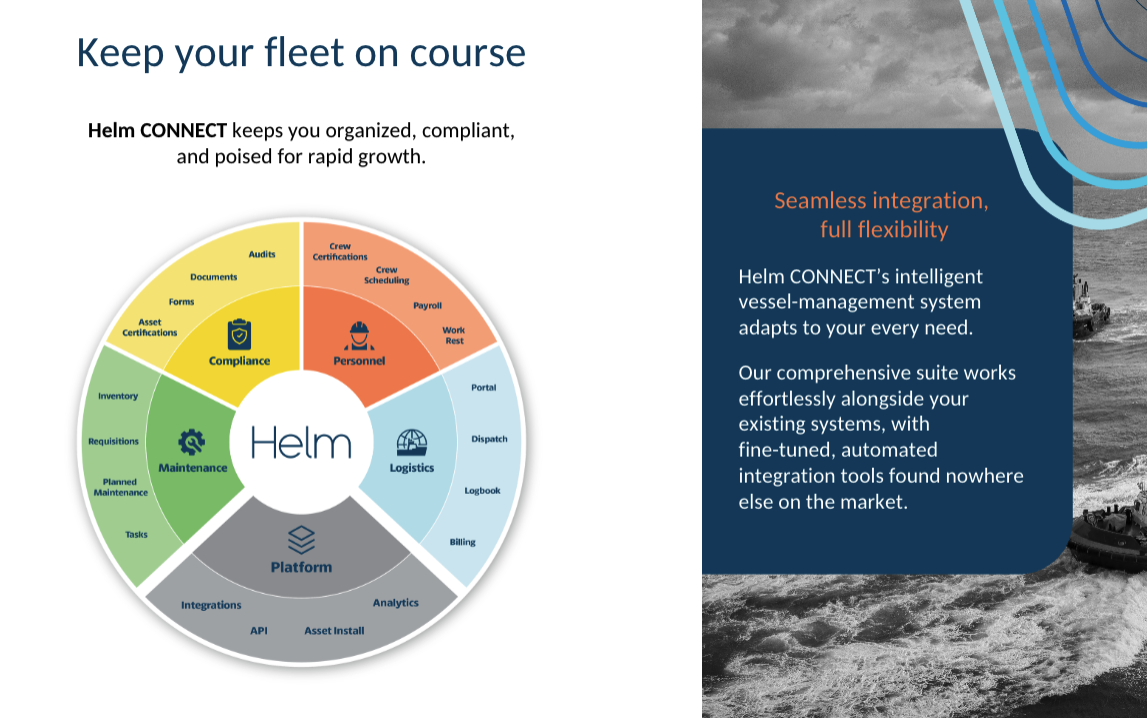
How Helm CONNECT does it better
Helm CONNECT is the world's leading maritime fleet management platform, trusted by more than 275 operators globally — and it was built for exactly this kind of regulatory shift. Operators used it to get ahead of Subchapter M in the United States; the new Marine Order 504 is the same story in Australian waters.
Here's how it maps to the new requirements:
Drills, safety meetings, and forms — all in one place. Crew record drills, toolbox talks, and safety meetings directly in Helm CONNECT, on board, without paper. Custom forms let you build MO504-specific checklists — fatigue self-assessments, stability modification records, pre-departure checks — and standardise them across your whole fleet.
Document control that keeps your SMS current. Store your procedures, emergency plans, drug and alcohol policy, and responsibility statements in a managed document system. Everyone works from the current version; superseded versions are archived automatically. When you update a procedure ashore, the fleet sees the change.
Certification tracking with automated reminders. Vessel certifications, crew qualifications, and survey dates are tracked with reminders well before expiry — no more discovering a lapsed certificate during an inspection.
Audits and corrective actions, end to end. Plan and run internal audits against your SMS, record findings, assign corrective actions, and track them to closure with a full audit trail. When AMSA — or a charterer — asks you to prove your system works, the evidence is a few clicks away.
Crew and work/rest management. Helm CONNECT Personnel tracks crew certifications, training, scheduling, and work/rest hours — the operational backbone of a credible fatigue risk management plan.
Real-time compliance dashboards. See certifications, forms, audits, and corrective actions across every vessel at a glance, and spot the gaps before an inspector does.
And unlike point solutions, Helm CONNECT doesn't stop at compliance. The same platform runs your maintenance, personnel, and operations — so your SMS isn't a separate silo, it's connected to how your fleet actually runs. Start with Compliance and add modules as you grow, with API integrations linking Helm to the systems you already use.
Backed by an Official Partner, locally
Software alone doesn't make you compliant — configuration does. As the Official Partner of Helm CONNECT, Tiller Technical works with Australian operators to map the new Marine Order 504 requirements into Helm CONNECT: building your MO504 form templates, structuring your document library, setting up audit schedules, and training your crews so the system sticks.
The revised order is already in force. Every month on paper is another month of records you can't easily prove, dates you might miss, and procedures drifting out of date.
Ready to see your SMS in Helm CONNECT? Fill in your details below and the Tiller Technical team will show you how your current SMS translates into a digital system built for the new Marine Order 504 — usually in under 30 minutes.
Tiller Technical — Official Partner of Helm CONNECT. This article is general guidance only and is not legal or regulatory advice. Refer to AMSA's published guidance and Marine Order 504 (Certificates of operation — national law) 2024 for the full requirements applying to your vessel.